# BustAPI
**Repository Path**: newchina/BustAPI
## Basic Information
- **Project Name**: BustAPI
- **Description**: BustAPI 是一个高性能 Python Web 框架,结合了 Python 和 Rust 两者的优势:Python 的简单性和 Rust 的原始性能。
- **Primary Language**: Python
- **License**: MIT
- **Default Branch**: main
- **Homepage**: None
- **GVP Project**: No
## Statistics
- **Stars**: 1
- **Forks**: 1
- **Created**: 2026-02-07
- **Last Updated**: 2026-06-25
## Categories & Tags
**Categories**: Uncategorized
**Tags**: None
## README
# BustAPI — High-Performance Python Web Framework

The fastest Python web framework for building REST APIs
Flask-like syntax • Rust-powered performance • Up to 20,000+ requests/sec




---
## ⚡ What is BustAPI?
BustAPI is a **production-ready Python web framework** that combines the best of both worlds: **Python's simplicity** and **Rust's raw performance**.
Under the hood, BustAPI runs on [Actix-Web](https://actix.rs/) — consistently ranked among the fastest web frameworks across all programming languages. But you never touch Rust. You write clean, familiar Python code with Flask-style decorators.
### Why BustAPI?
| Problem | BustAPI Solution |
| ------------------------------ | ------------------------------------------ |
| Python web frameworks are slow | Rust core handles HTTP, JSON, routing |
| ASGI/WSGI adds overhead | Built-in server, no middleware layers |
| Scaling requires complex setup | Native multiprocessing with `SO_REUSEPORT` |
| Auth is always a pain | JWT, sessions, Argon2 hashing built-in |
### Key Highlights
- 🚀 **20,000+ RPS** out of the box — 5x faster than Flask
- 🦀 **Rust-powered** — Zero-copy JSON, mimalloc allocator, Actix-Web
- 🐍 **Pure Python API** — No Rust knowledge required
- 🔒 **Security built-in** — JWT, sessions, CSRF, rate limiting
- 🛡️ **Robust Header System** — Case-insensitive, multi-value support, high-performance cookie parsing
- 📦 **Zero config** — `pip install bustapi` and you're ready
- 🔥 **Hot reload** — Rust-native file watcher for instant restarts
```python
from bustapi import BustAPI
app = BustAPI()
@app.route("/")
def hello():
return {"message": "Hello, world!"}
if __name__ == "__main__":
app.run()
```
No ASGI servers needed. No complex configuration. Just run your file.
---
## 🏗️ Architecture
```
┌─────────────────────────────────────────────────────────────┐
│ Your Python Code │
│ (Flask-like decorators & handlers) │
├─────────────────────────────────────────────────────────────┤
│ PyO3 Bindings (v0.27) │
│ (Zero-cost Python ↔ Rust bridge) │
├─────────────────────────────────────────────────────────────┤
│ Rust Core (bustapi_core) │
│ ┌─────────────┐ ┌─────────────┐ ┌─────────────────────────┐│
│ │ Actix-Web │ │ serde_json │ │ mimalloc allocator ││
│ │ HTTP Server │ │ Zero-copy │ │ Optimized memory ││
│ └─────────────┘ └─────────────┘ └─────────────────────────┘│
└─────────────────────────────────────────────────────────────┘
```
| Component | Technology | Purpose |
| ------------- | ------------- | ------------------------------ |
| HTTP Server | Actix-Web 4.x | Ultra-fast async HTTP handling |
| Serialization | serde_json | Zero-copy JSON encoding |
| Memory | mimalloc | High-performance allocator |
| Bindings | PyO3 0.27 | Python 3.10–3.14 support |
| Async Runtime | Tokio | Non-blocking I/O |
---
## 📦 Installation
```bash
pip install bustapi
```
**Supports:** Python 3.10 – 3.14 | Linux, macOS, Windows | x86_64 & ARM64
Pre-built wheels available — no Rust toolchain required!
---
## ✨ Features
### 🛣️ Routing
- **Dynamic Routes** — `/users/` with automatic type validation
- **Blueprints** — Modular app organization (Flask-style)
- **Turbo Routes** — Zero-overhead handlers for maximum speed
- **Wildcard Paths** — `` for catch-all routes
### 🔐 Authentication & Security
- **JWT** — Create/validate tokens (HS256, HS384, HS512)
- **Sessions** — Flask-Login compatible user management
- **Password Hashing** — Argon2id (OWASP recommended)
- **CSRF Protection** — Built-in token validation
- **Rate Limiting** — Rust-powered request throttling
### 🌐 HTTP Features
- **WebSocket** — Full duplex communication + Turbo mode
- **Streaming** — HTTP Range requests, video seeking
- **File Uploads** — Multipart form handling
- **Static Files** — Efficient serving with caching
### 🛠️ Developer Experience
- **Hot Reload** — Rust-native file watcher (instant restarts)
- **Templates** — Built-in Jinja2 via MiniJinja
- **CLI Tool** — `bustapi new`, `bustapi run`, `bustapi routes`
- **Auto-docs** — OpenAPI/Swagger generation
- **Testing** — Built-in `TestClient` for unit tests
### 🔌 Compatibility
- **ASGI/WSGI** — Works with Uvicorn, Gunicorn, Hypercorn
- **FastAPI-style** — `Query()`, `Path()`, `Body()`, `Depends()`
- **Flask-style** — `request`, `session`, `g`, `current_app`
---
## 🚀 Quick Start
**1. Create `app.py`:**
```python
from bustapi import BustAPI, jsonify
app = BustAPI()
@app.route("/")
def home():
return {"status": "running", "framework": "BustAPI"}
@app.route("/users/")
def get_user(user_id):
return jsonify({"id": user_id, "name": "Alice"})
@app.route("/greet", methods=["POST"])
def greet():
from bustapi import request
data = request.json
return {"message": f"Hello, {data.get('name', 'World')}!"}
if __name__ == "__main__":
app.run(debug=True) # Hot reload enabled
```
**2. Run it:**
```bash
python app.py
```
**3. Visit** `http://127.0.0.1:5000`
---
## ⚡ Turbo Routes
For **maximum performance**, use `@app.turbo_route()`. Path parameters are parsed entirely in Rust:
```python
# Zero-overhead static route
@app.turbo_route("/health")
def health():
return {"status": "ok"}
# Dynamic route with typed params (parsed in Rust)
@app.turbo_route("/users/")
def get_user(id: int):
return {"id": id, "name": f"User {id}"}
# Cached response (140k+ RPS!)
@app.turbo_route("/config", cache_ttl=60)
def get_config():
return {"version": "1.0", "env": "production"}
```
**Supported types:** `int`, `float`, `str`, `path`
> ⚠️ **Note:** Turbo routes skip middleware, sessions, and request context for speed. Use `@app.route()` when you need those features.
---
## 📊 Benchmarks
### Standard Routes (`@app.route()`)
| Platform | RPS | Mode |
| --------- | ----------: | -------------- |
| **Linux** | **~25,000** | Single-process |
| macOS | ~20,000 | Single-process |
| Windows | ~17,000 | Single-process |
### Turbo Routes (`@app.turbo_route()`) — Linux
| Configuration | RPS |
| ------------------------------- | ---------------: |
| Static route | ~30,000 (single) |
| **Multiprocessing (4 workers)** | **~105,000** |
| **Cached (60s TTL)** | **~140,000** |
### Framework Comparison (Turbo + Multiprocessing)

---
## 🌍 Platform Support
### 🐧 Linux (Recommended for Production)
Linux delivers the **best performance** with native multiprocessing:
- **~25k RPS** standard routes, **100k+ RPS** with Turbo + multiprocessing
- Kernel-level load balancing via `SO_REUSEPORT`
- Automatic worker scaling to CPU cores
```bash
python app.py # Automatically uses multiprocessing
```
### 🍎 macOS (Development)
Fully supported for development. Single-process mode (~35k RPS):
```bash
pip install bustapi && python app.py
```
### 🪟 Windows (Development)
Fully supported for development. Single-process mode (~17k RPS):
```bash
pip install bustapi && python app.py
```
> 💡 **Tip:** For production, deploy on **Linux servers** to unlock multiprocessing performance.
---
## 🔐 Authentication
### JWT Tokens
```python
from bustapi import BustAPI
from bustapi.jwt import JWT
app = BustAPI()
jwt = JWT(app, secret_key="your-secret-key")
@app.route("/login", methods=["POST"])
def login():
# Validate credentials...
token = jwt.create_access_token(identity=user_id)
return {"access_token": token}
@app.route("/protected")
@jwt.jwt_required()
def protected():
return {"user": jwt.get_jwt_identity()}
```
### Session Login
```python
from bustapi.auth import LoginManager, login_user, current_user, login_required
login_manager = LoginManager(app)
@login_manager.user_loader
def load_user(user_id):
return User.get(user_id)
@app.route("/login", methods=["POST"])
def login():
user = authenticate(request.form)
login_user(user)
return redirect("/dashboard")
@app.route("/dashboard")
@login_required
def dashboard():
return f"Welcome, {current_user.name}!"
```
### Password Hashing
```python
from bustapi.auth import hash_password, verify_password
# Hash (Argon2id)
hashed = hash_password("mysecretpassword")
# Verify
if verify_password("mysecretpassword", hashed):
print("Password correct!")
```
---
## 🌐 WebSocket
```python
@app.websocket("/ws")
async def websocket_handler(ws):
await ws.accept()
while True:
message = await ws.receive_text()
await ws.send_text(f"Echo: {message}")
```
**Turbo WebSocket** (Pure Rust, ~74% faster):
```python
@app.turbo_websocket("/ws/turbo")
def turbo_handler(message: str) -> str:
return f"Echo: {message}" # Processed entirely in Rust
```
---
## 🧪 Testing
```python
from bustapi.testing import TestClient
def test_homepage():
client = TestClient(app)
response = client.get("/")
assert response.status_code == 200
assert response.json() == {"status": "running"}
def test_create_user():
response = client.post("/users", json={"name": "Alice"})
assert response.status_code == 201
```
---
## 📁 Project Structure
```
bustapi/
├── src/ # Rust core
│ ├── lib.rs # PyO3 module entry
│ ├── bindings/ # Python ↔ Rust bridge
│ ├── router/ # URL matching engine
│ ├── server/ # Actix-Web handlers
│ ├── websocket/ # WS session management
│ ├── jwt.rs # Token encoding/decoding
│ └── crypto.rs # Argon2, CSRF, tokens
│
├── python/bustapi/ # Python package
│ ├── app.py # BustAPI main class
│ ├── auth/ # JWT, sessions, CSRF
│ ├── routing/ # Blueprints, decorators
│ ├── params.py # Query/Path/Body validators
│ └── websocket.py # WebSocket API
│
├── examples/ # 30+ usage examples
├── tests/ # Comprehensive test suite
├── docs/ # MkDocs documentation
└── benchmarks/ # Performance tools
```
---
## 🛠️ CLI Tool
```bash
# Create new project
bustapi new myproject
# Run with hot reload
bustapi run
# List all routes
bustapi routes
# Show system info
bustapi info
```
---
## 🚢 Deployment
### Built-in Server (Recommended)
```bash
python app.py
```
Uses the internal Rust HTTP server. Best performance, zero dependencies.
### With ASGI (Uvicorn)
```bash
pip install uvicorn
uvicorn app:app.asgi_app --host 0.0.0.0 --port 8000
```
### With Docker
```dockerfile
FROM python:3.12-slim
WORKDIR /app
COPY requirements.txt .
RUN pip install --no-cache-dir -r requirements.txt
COPY . .
EXPOSE 5000
CMD ["python", "app.py"]
```
---
## 📖 Documentation
📚 **[Full Documentation](https://RUSTxPY.github.io/BustAPI/)**
- [Getting Started](https://RUSTxPY.github.io/BustAPI/quickstart/)
- [Routing Guide](https://RUSTxPY.github.io/BustAPI/user-guide/routing/)
- [JWT Authentication](https://RUSTxPY.github.io/BustAPI/user-guide/jwt/)
- [WebSocket Guide](https://RUSTxPY.github.io/BustAPI/user-guide/websocket/)
- [API Reference](https://RUSTxPY.github.io/BustAPI/api-reference/)
---
## 🤝 Contributing
We welcome contributions! Here's how:
1. **Fork** the repository
2. **Create** a feature branch (`git checkout -b feature/amazing`)
3. **Commit** your changes (`git commit -m 'Add amazing feature'`)
4. **Push** to the branch (`git push origin feature/amazing`)
5. **Open** a Pull Request
Found a bug? Have a feature request?
- [Open an Issue](https://github.com/RUSTxPY/BustAPI/issues)
- [Start a Discussion](https://github.com/RUSTxPY/BustAPI/discussions)
---
## 💰 Support
If BustAPI helps your project, consider supporting its development:
**Binance ID:** `1010167458`
---
## 🌠 Star History
[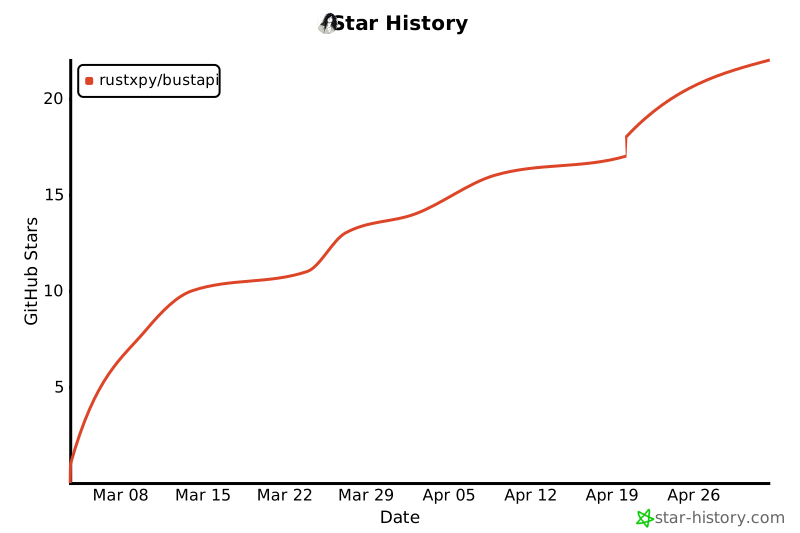](https://www.star-history.com/#RUSTxPY/BustAPI&Date)
---
## 📄 License
[MIT](LICENSE) © 2025-2026 **[GrandpaEJ](https://github.com/GrandpaEJ)**
---
Built with 🦀 Rust + 🐍 Python
Fast. Simple. Production-ready.