# meltingpot
**Repository Path**: mirrors_deepmind/meltingpot
## Basic Information
- **Project Name**: meltingpot
- **Description**: A suite of test scenarios for multi-agent reinforcement learning.
- **Primary Language**: Unknown
- **License**: Apache-2.0
- **Default Branch**: main
- **Homepage**: None
- **GVP Project**: No
## Statistics
- **Stars**: 0
- **Forks**: 0
- **Created**: 2021-07-17
- **Last Updated**: 2026-05-17
## Categories & Tags
**Categories**: Uncategorized
**Tags**: None
## README
# Melting Pot
*A suite of test scenarios for multi-agent reinforcement learning.*
[](https://pypi.python.org/pypi/dm-meltingpot)
[](https://pypi.python.org/pypi/dm-meltingpot)
[](../../actions/workflows/pypi-test.yml)
[](../../actions/workflows/test-meltingpot.yml)
[](../../actions/workflows/test-examples.yml)
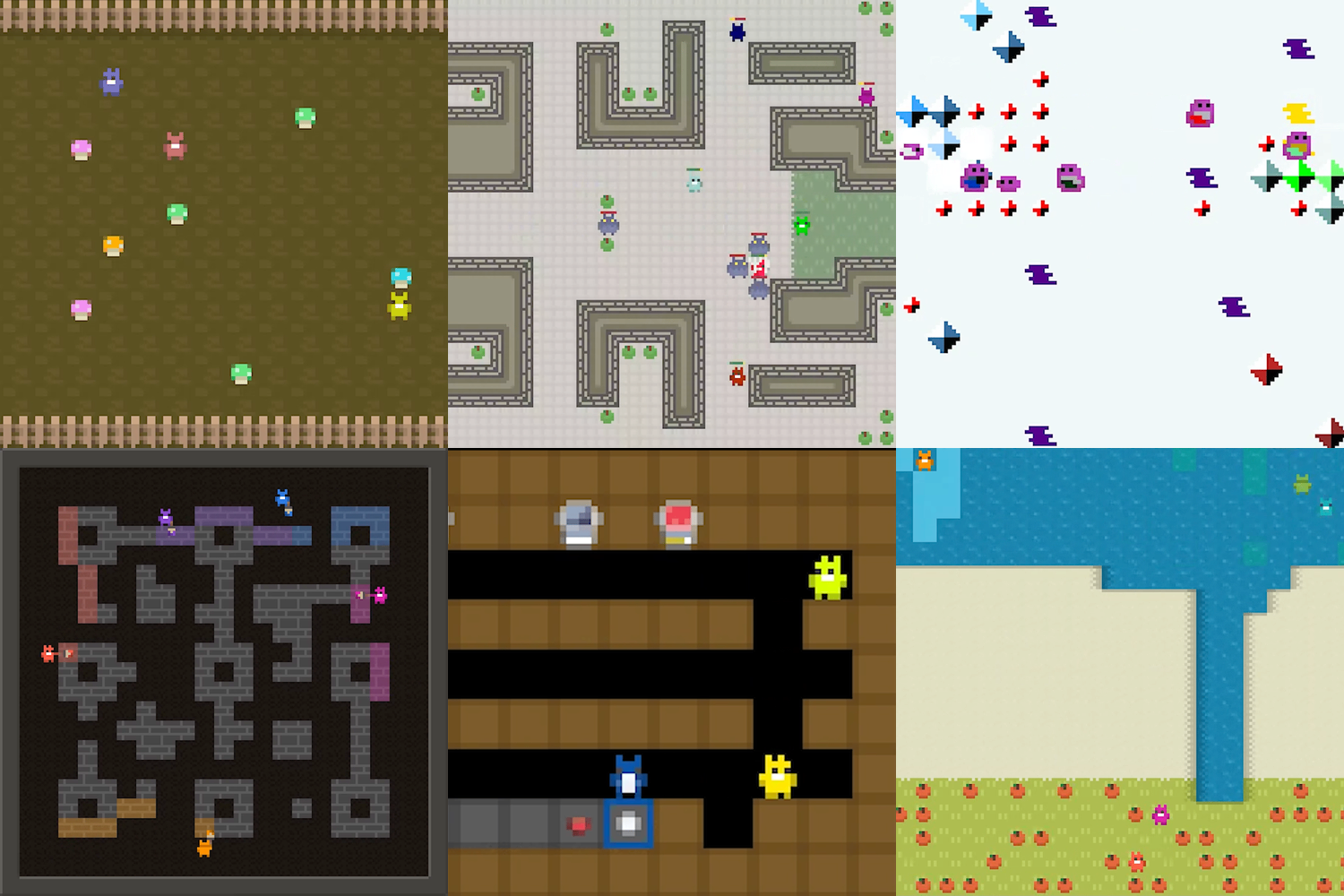
[Melting Pot 2.0 Tech Report](https://arxiv.org/abs/2211.13746)
[Melting Pot Contest at NeurIPS 2023](https://www.aicrowd.com/challenges/meltingpot-challenge-2023)
## About
Melting Pot assesses generalization to novel social situations involving both
familiar and unfamiliar individuals, and has been designed to test a broad range
of social interactions such as: cooperation, competition, deception,
reciprocation, trust, stubbornness and so on. Melting Pot offers researchers a
set of over 50 multi-agent reinforcement learning _substrates_ (multi-agent
games) on which to train agents, and over 256 unique test _scenarios_ on which
to evaluate these trained agents. The performance of agents on these held-out
test scenarios quantifies whether agents:
* perform well across a range of social situations where individuals are
interdependent,
* interact effectively with unfamiliar individuals not seen during training
The resulting score can then be used to rank different multi-agent RL algorithms
by their ability to generalize to novel social situations.
We hope Melting Pot will become a standard benchmark for multi-agent
reinforcement learning. We plan to maintain it, and will be extending it in the
coming years to cover more social interactions and generalization scenarios.
If you are interested in extending Melting Pot, please refer to the
[Extending Melting Pot](https://github.com/google-deepmind/meltingpot/blob/main/docs/extending.md) documentation.
## Installation
Melting Pot is available on PyPI](https://pypi.python.org/pypi/dm-meltingpot)
and can be installed using:
```shell
pip install dm-meltingpot
```
After doing this you can then `import meltingpot` in your own code.
NOTE: Melting Pot is built on top of [DeepMind Lab2D](https://github.com/google-deepmind/lab2d)
which is distributed as pre-built wheels. If there is no appropriate wheel for
`dmlab2d`, you will need to build it from source (see
[the `dmlab2d` `README.md`](https://github.com/google-deepmind/lab2d/blob/main/README.md)
for details).
## Development
### Codespace
The easiest way to work on the Melting Pot source code, is to use our
pre-configured development environment via a
[Github CodeSpace](https://github.com/features/codespaces).
This provides a tested development workflow that allows for reproducible builds,
and minimizes dependency management. We strongly advise preparing all Pull
Requests for Melting Pot via this workflow.
### Manual setup
If you want to work on the Melting Pot source code within your own development
environment you will have to handle installation and dependency management
yourself.
For example, you can perform an editable installation as follows:
1. Clone Melting Pot:
```shell
git clone -b main https://github.com/google-deepmind/meltingpot
cd meltingpot
```
2. Create and activate a virtual environment:
```shell
python -m venv venv
source venv/bin/activate
```
3. Install Melting Pot:
```shell
pip install --editable .[dev]
```
4. Test the installation:
```shell
pytest --pyargs meltingpot
```
## Example usage
### Evaluation
The [evaluation](https://github.com/google-deepmind/meltingpot/blob/main/meltingpot/utils/evaluation/evaluation.py) library can be used
to evaluate [SavedModel](https://www.tensorflow.org/guide/saved_model)s
trained on Melting Pot substrates.
Evaluation results from the [Melting Pot 2.0 Tech Report](https://arxiv.org/abs/2211.13746)
can be viewed in the [Evaluation Notebook](https://github.com/google-deepmind/meltingpot/blob/main/notebooks/evaluation_results.ipynb).
[](https://colab.research.google.com/github/deepmind/meltingpot/blob/main/notebooks/evaluation_results.ipynb)
### Interacting with the substrates
You can try out the substrates interactively with the
[human_players](https://github.com/google-deepmind/meltingpot/blob/main/meltingpot/human_players) scripts. For example, to play
the `clean_up` substrate, you can run:
```shell
python meltingpot/human_players/play_clean_up.py
```
You can move around with the `W`, `A`, `S`, `D` keys, Turn with `Q`, and `E`,
fire the zapper with `1`, and fire the cleaning beam with `2`. You can switch
between players with `TAB`. There are other substrates available in the
[human_players](https://github.com/google-deepmind/meltingpot/blob/main/meltingpot/human_players) directory. Some have multiple
variants, which you select with the `--level_name` flag.
### Training agents
We provide an illustrative example script using
[RLlib](https://github.com/ray-project/ray). However, note
that Melting Pot is agnostic to how you train your agents, and this
script is not meant to be a suggestion for how to achieve a good score
in the task suite. The authors of the suite never used this example training
script in their own work.
#### RLlib
This example uses RLlib to train agents in
self-play on a Melting Pot substrate.
First you will need to install the dependencies needed by the examples:
```shell
cd
pip install -r examples/requirements.txt
```
Then you can run the training experiment using:
```shell
cd examples/rllib
python self_play_train.py
```
## Documentation
Full documentation is available [here](https://github.com/google-deepmind/meltingpot/blob/main/docs/index.md).
## Citing Melting Pot
If you use Melting Pot in your work, please cite the accompanying articles:
```bibtex
@inproceedings{leibo2021meltingpot,
title={Scalable Evaluation of Multi-Agent Reinforcement Learning with
Melting Pot},
author={Joel Z. Leibo AND Edgar Du\'e\~nez-Guzm\'an AND Alexander Sasha
Vezhnevets AND John P. Agapiou AND Peter Sunehag AND Raphael Koster
AND Jayd Matyas AND Charles Beattie AND Igor Mordatch AND Thore
Graepel},
year={2021},
journal={International conference on machine learning},
organization={PMLR},
url={https://doi.org/10.48550/arXiv.2107.06857},
doi={10.48550/arXiv.2107.06857}
}
```
```bibtex
@article{agapiou2022melting,
title={Melting Pot 2.0},
author={Agapiou, John P and Vezhnevets, Alexander Sasha and Du{\'e}{\~n}ez-Guzm{\'a}n, Edgar A and Matyas, Jayd and Mao, Yiran and Sunehag, Peter and K{\"o}ster, Raphael and Madhushani, Udari and Kopparapu, Kavya and Comanescu, Ramona and Strouse, {DJ} and Johanson, Michael B and Singh, Sukhdeep and Haas, Julia and Mordatch, Igor and Mobbs, Dean and Leibo, Joel Z},
journal={arXiv preprint arXiv:2211.13746},
year={2022}
}
```
## Disclaimer
This is not an officially supported Google product.