# sponge
**Repository Path**: lamplance/sponge
## Basic Information
- **Project Name**: sponge
- **Description**: sponge是一个强大的Go开发框架,提供一站式项目开发解决方案,涵盖代码生成、开发、测试、API 文档生成和部署,大幅提升开发效率,降低开发难度,实现以"低代码"方式开发RESTful API,gRPC和微服务项目。
- **Primary Language**: Go
- **License**: MIT
- **Default Branch**: main
- **Homepage**: https://github.com/go-dev-frame/sponge
- **GVP Project**: No
## Statistics
- **Stars**: 0
- **Forks**: 9
- **Created**: 2025-02-11
- **Last Updated**: 2025-03-19
## Categories & Tags
**Categories**: Uncategorized
**Tags**: None
## README
## English | [简体中文](assets/readme-cn.md)

[](https://goreportcard.com/report/github.com/go-dev-frame/sponge)
[](https://codecov.io/gh/go-dev-frame/sponge)
[](https://pkg.go.dev/github.com/go-dev-frame/sponge)
[](https://github.com/go-dev-frame/sponge/actions)
[](https://github.com/avelino/awesome-go)
[](https://img.shields.io/github/license/go-dev-frame/sponge)
**Sponge** is a powerful `Go` development framework. Its core concept revolves around reverse-engineering modular code by parsing `JSON`, `SQL`, or `Protobuf` files. The generated code can be flexibly and seamlessly assembled into various types of complete backend services (`similar to the characteristics of sponge cells, where disassembled sponge cells can automatically recombine into a new sponge`).
Sponge provides an all-in-one solution for project development, covering code generation, development, testing, API documentation, and deployment, significantly enhancing development efficiency, reducing complexity, and enabling high-quality projects with a "low-code approach".
### Applicable scenarios
Sponge is suitable for quickly developing various high-performance backend services, including but not limited to:
- `Web` services (gin);
- `gRPC` services;
- `HTTP+gRPC` hybrid services;
- `gRPC Gateway API` services;
- cloud-native microservices.
Additionally, developers can use custom templates to generate various types of code to meet specific business needs.
### Core Highlights
1. **One-click generation of complete backend service code**
For `Web` or `gRPC` services that only require `CRUD APIs`, no `Go` code needs to be written. Simply connect to a database (e.g., `MySQL`, `MongoDB`, `PostgreSQL`, `SQLite`) to one-click generate complete backend service code and easily deploy it to Linux servers, Docker, or Kubernetes.
2. **Efficient development of general-purpose services**
When developing general-purpose `Web`, `gRPC`, `HTTP+gRPC`, or `gRPC Gateway` services, you only need to focus on three aspects:
- Defining database tables;
- Defining API descriptions in Protobuf files;
- Writing business logic code in the generated templates.
The framework code and CRUD API code are all automatically generated by sponge.
3. **Support for custom templates, offering flexible extensibility**
sponge supports generating various types of project-specific code using custom templates, not limited to the `Go` language. For example:
- Backend code;
- Frontend code;
- Configuration files;
- Test code;
- Build and deployment scripts, etc.
4. **Generate code on the page, simple and easy to use**
### Quick Start
1. **Install sponge**
Sponge supports installation on Windows, macOS, and Linux. Click to view the [**sponge installation guide**](https://github.com/go-dev-frame/sponge/blob/main/assets/install-cn.md).
2. **Open the code generation UI**
After installation, run the following command to open the sponge UI:
```bash
sponge run
```
Access `http://localhost:24631` in a local browser to generate code through the UI interface, as shown below:
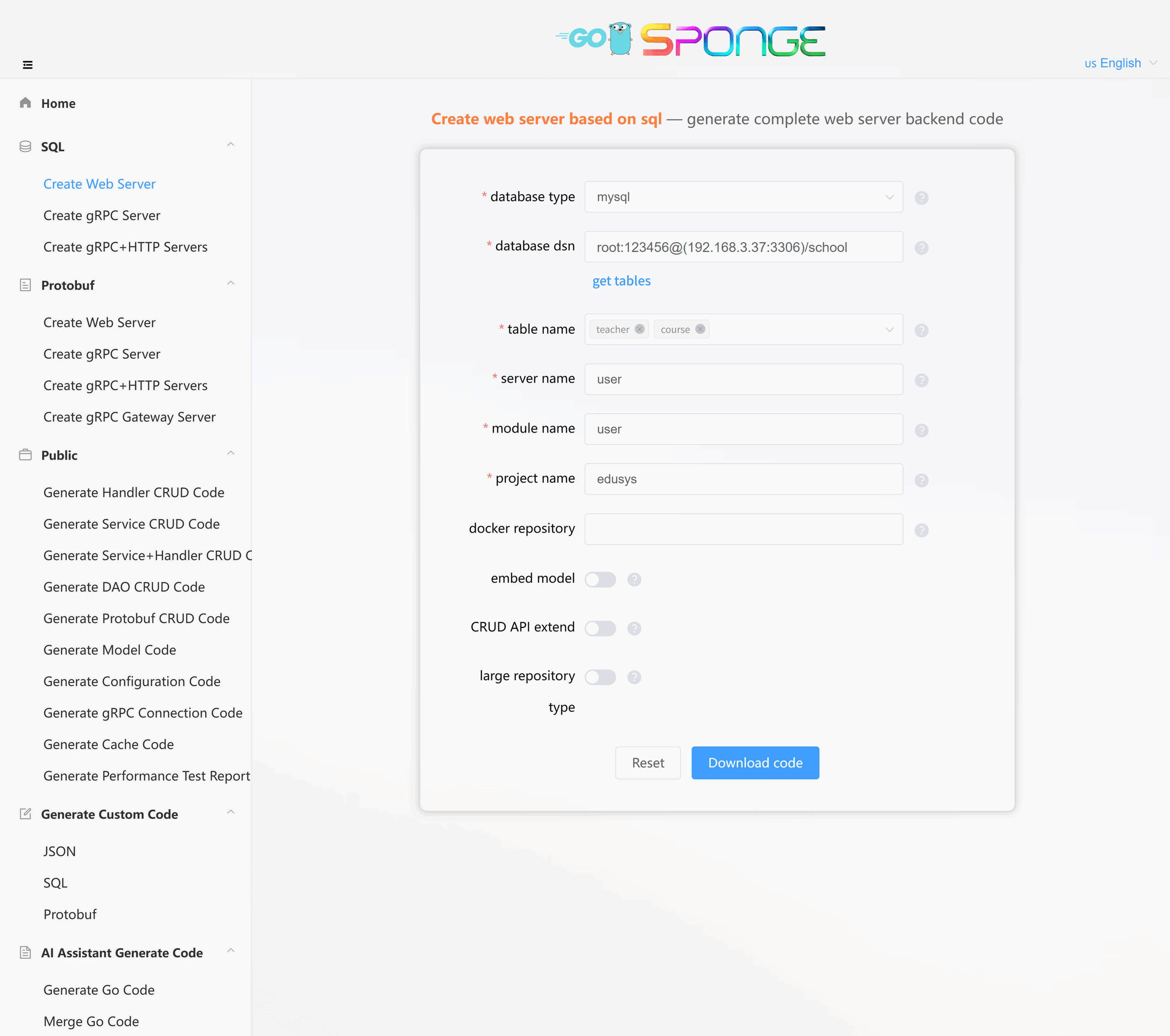
> To access from a browser on a different host, specify the host IP or domain when starting the UI, e.g., `sponge run -a http://your_host_ip:24631`. Alternatively, you can run the UI service in Docker to support cross-host access. Click to view the guide on [running the sponge UI service in Docker](https://github.com/go-dev-frame/sponge/blob/main/assets/install-cn.md#Docker%E7%8E%AF%E5%A2%83).
### Main Features
Sponge has built-in rich features (for on-demand use):
- Web framework [gin](https://github.com/gin-gonic/gin)
- RPC framework [grpc](https://github.com/grpc/grpc-go)
- Configuration parsing [viper](https://github.com/spf13/viper)
- Logging component [zap](https://github.com/uber-go/zap)
- ORM framework [gorm](https://github.com/go-gorm/gorm), [mongo-go-driver](https://github.com/mongodb/mongo-go-driver)
- Cache [go-redis](https://github.com/go-redis/redis), [ristretto](https://github.com/dgraph-io/ristretto)
- Automated API documentation [swagger](https://github.com/swaggo/swag), [protoc-gen-openapiv2](https://github.com/grpc-ecosystem/grpc-gateway/v2/protoc-gen-openapiv2)
- Authentication [jwt](https://github.com/golang-jwt/jwt)
- Websocket [gorilla/websocket](https://github.com/gorilla/websocket)
- Crontab [cron](https://github.com/robfig/cron)
- Message Queue [rabbitmq](https://github.com/rabbitmq/amqp091-go), [kafka](https://github.com/IBM/sarama)
- Distributed Transaction Manager [dtm](https://github.com/dtm-labs/dtm)
- Distributed lock [dlock](https://github.com/go-dev-frame/sponge/tree/main/pkg/dlock)
- Parameter validation [validator](https://github.com/go-playground/validator)
- Adaptive rate limiting [ratelimit](https://github.com/go-dev-frame/sponge/tree/main/pkg/shield/ratelimit)
- Adaptive circuit breaking [circuitbreaker](https://github.com/go-dev-frame/sponge/tree/main/pkg/shield/circuitbreaker)
- Distributed Tracing [opentelemetry](https://github.com/open-telemetry/opentelemetry-go)
- Metrics monitoring [prometheus](https://github.com/prometheus/client_golang/prometheus), [grafana](https://github.com/grafana/grafana)
- Service registration and discovery [etcd](https://github.com/etcd-io/etcd), [consul](https://github.com/hashicorp/consul), [nacos](https://github.com/alibaba/nacos)
- Adaptive collecting [profile](https://go.dev/blog/pprof)
- Resource statistics [gopsutil](https://github.com/shirou/gopsutil)
- Configuration center [nacos](https://github.com/alibaba/nacos)
- Code quality checking [golangci-lint](https://github.com/golangci/golangci-lint)
- Continuous integration and deployment [jenkins](https://github.com/jenkinsci/jenkins), [docker](https://www.docker.com/), [kubernetes](https://github.com/kubernetes/kubernetes)
- Generate project business architecture diagram [spograph](https://github.com/go-dev-frame/spograph)
- Custom template generation code [go template](https://pkg.go.dev/text/template@go1.23.3)
### Generates Code Framework
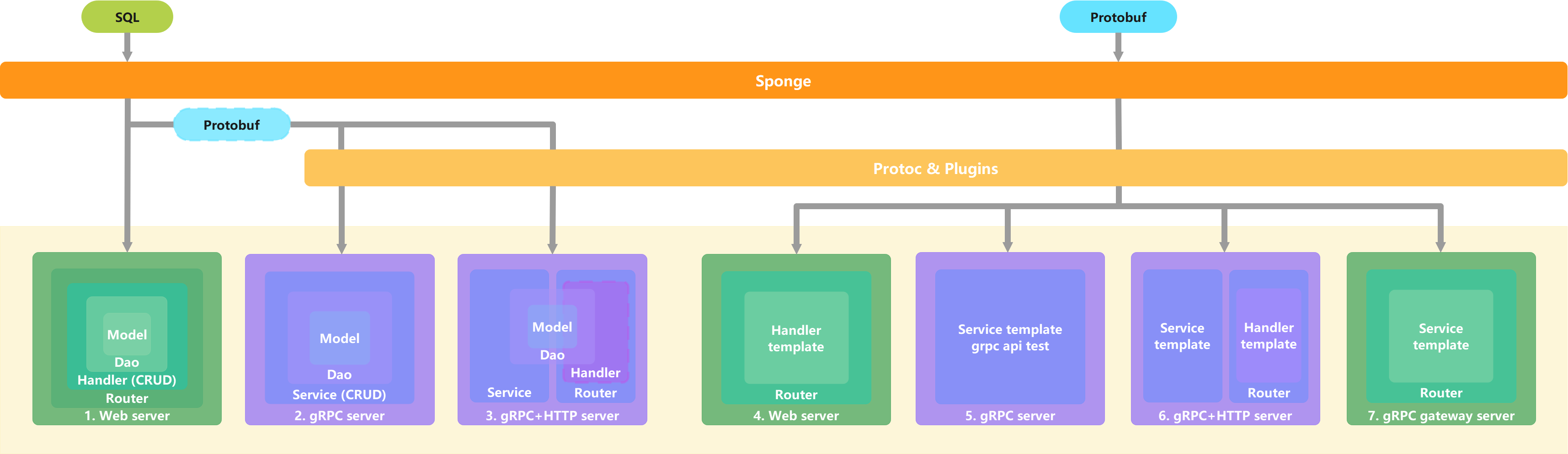
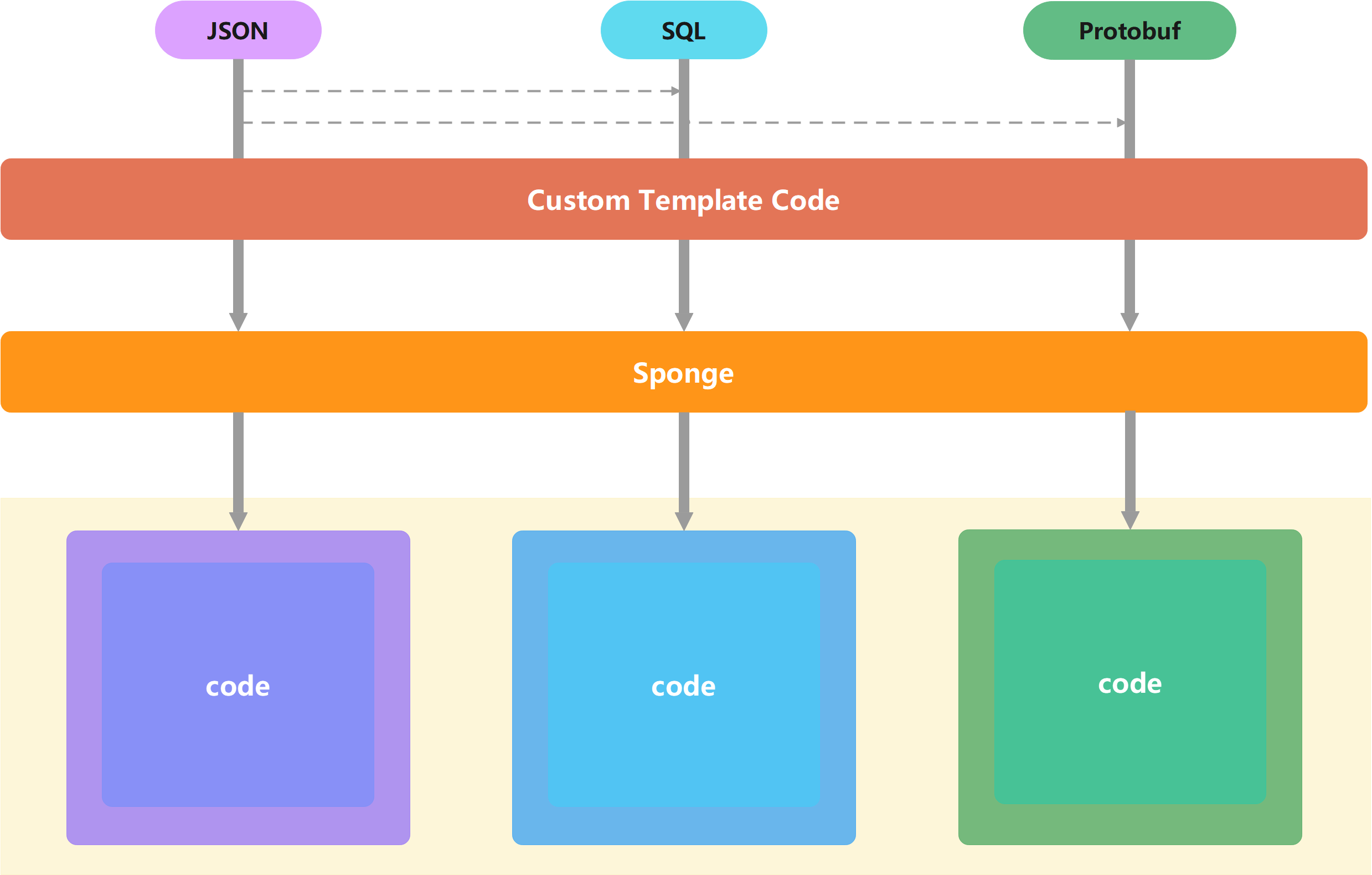
Sponge supports generating code using both built-in templates and custom templates, as shown in the diagrams below.
1. The code generation framework based on Sponge's built-in templates is shown below. There are two approaches: SQL and Protobuf.
2. The code generation framework based on custom templates is shown below. There are three approaches: JSON, SQL, and Protobuf.
### Microservice framework
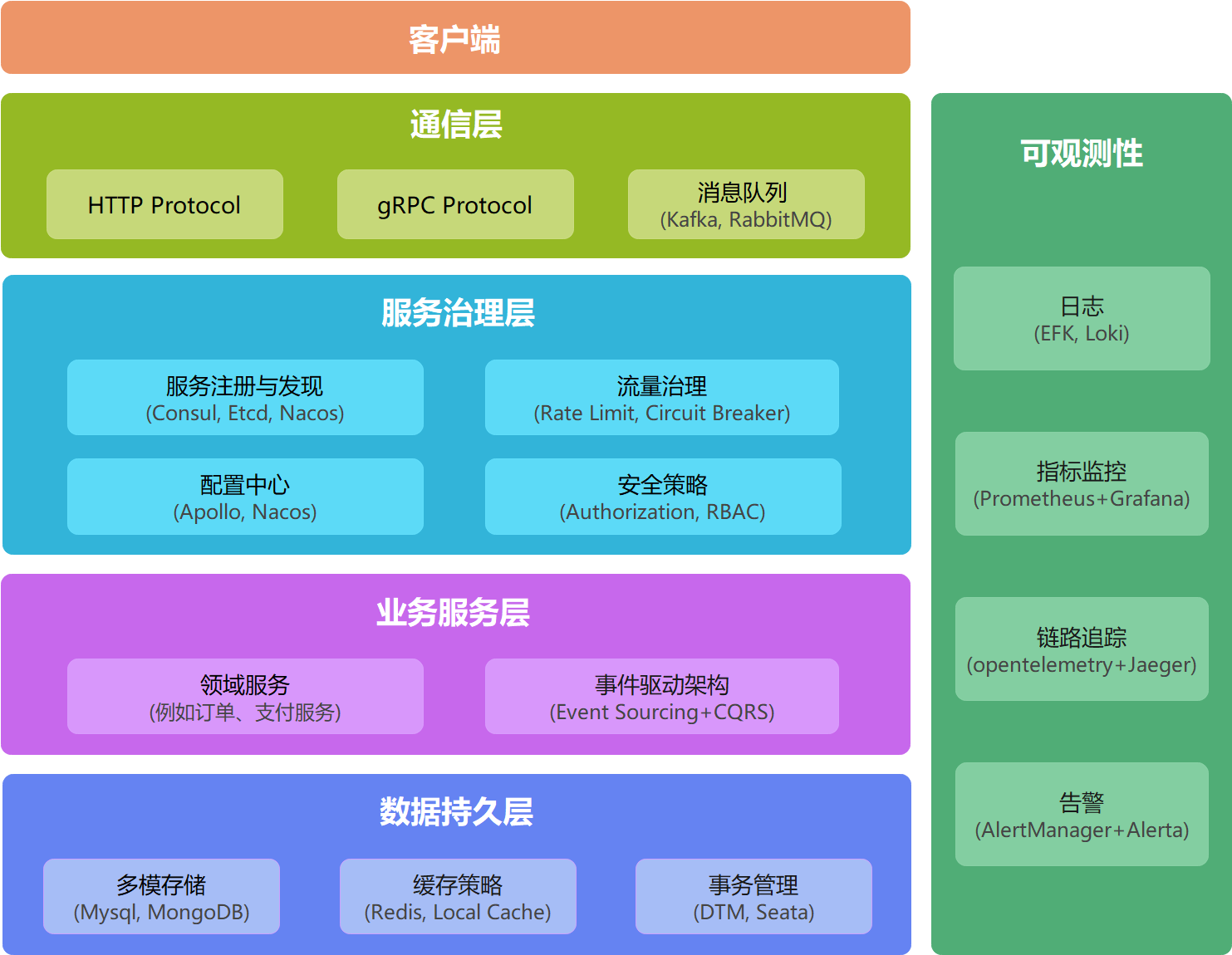
Five of the six types of back-end services created by sponge are microservice architectures. The diagram below illustrates a typical layered microservice structure, featuring high performance, scalability, and built-in service governance capabilities.
Performance testing of http and grpc service code created by the microservices framework: 50 concurrent, 1 million total requests.
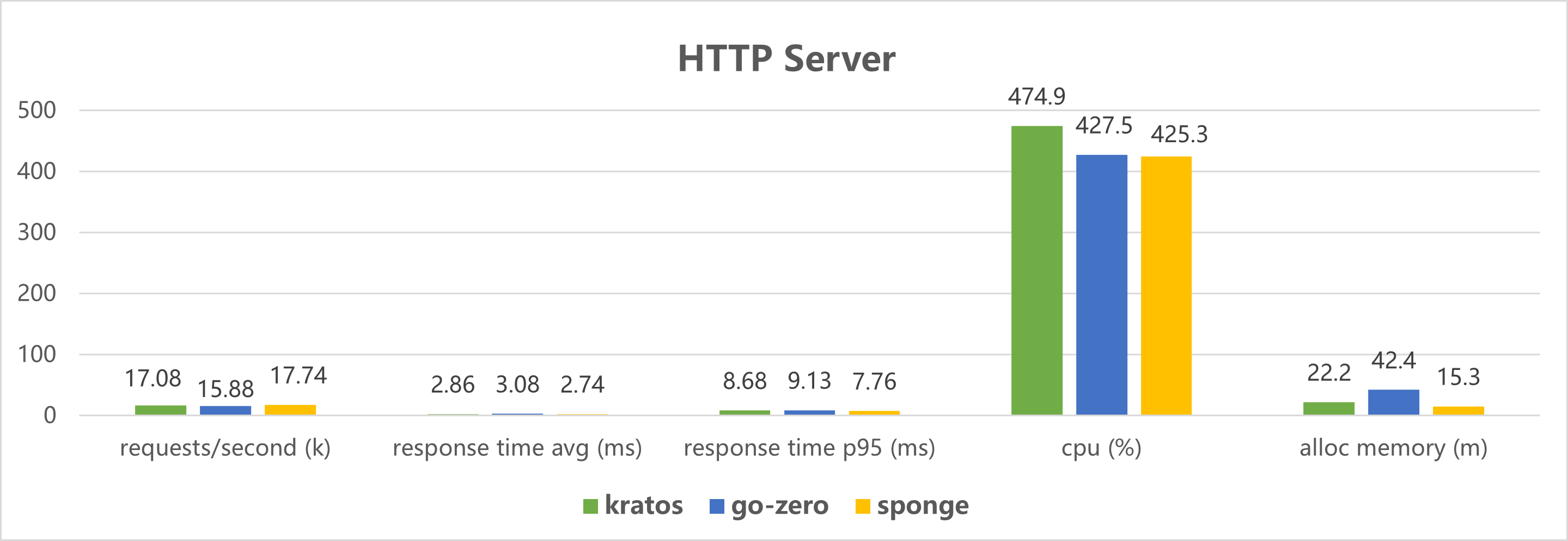
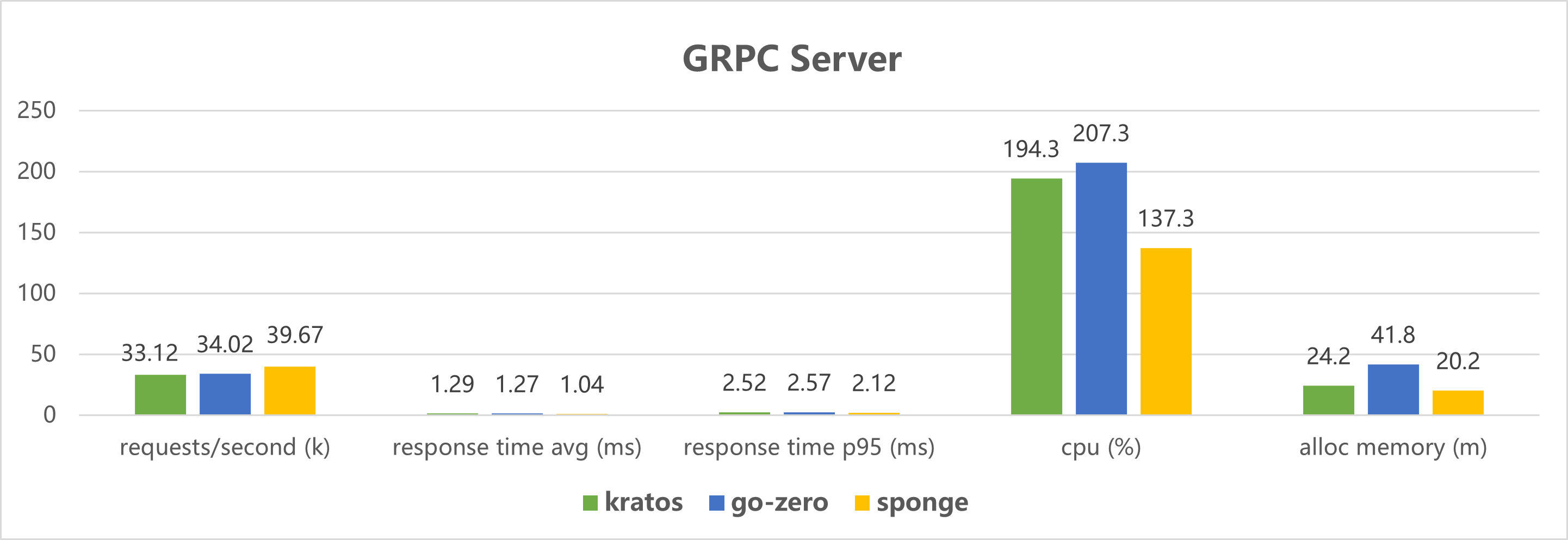
Click to view the [**test code**](https://github.com/zhufuyi/microservices_framework_benchmark).
### Project Code Directory Structure
The project code directory structure created by sponge follows the [project-layout](https://github.com/golang-standards/project-layout).
Sponge supports creating three types of project code structures: `Monolithic application monorepo (monolith)`, `Microservices multi-repo (multi-repo)`, and `Microservices monorepo (mono-repo)`.
1. The code directory structure for creating a `Monolithic application monorepo (monolith)` or `Microservices multi-repo (multi-repo)` is as follows:
```bash
.
├── api # Protobuf files and generated * pb.go directory
├── assets # Store various static resources, such as images, markdown files, etc.
├── cmd # Program entry directory
├── configs # Directory for configuration files
├── deployments # Bare metal, docker, k8s deployment script directory.
├── docs # Directory for API interface Swagger documentation.
├── internal # Directory for business logic code.
│ ├── cache # Cache directory wrapped around business logic.
│ ├── config # Directory for Go structure configuration files.
│ ├── dao # Data access directory.
│ ├── database # database directory.
│ ├── ecode # Directory for system error codes and custom business error codes.
│ ├── handler # Directory for implementing HTTP business functionality (specific to web services).
│ ├── model # Database model directory.
│ ├── routers # HTTP routing directory.
│ ├── rpcclient # Directory for client-side code that connects to grpc services.
│ ├── server # Directory for creating services, including HTTP and grpc.
│ ├── service # Directory for implementing grpc business functionality (specific to grpc services).
│ └── types # Directory for defining request and response parameter structures for HTTP.
├── pkg # Directory for shared libraries.
├── scripts # Directory for scripts.
├── test # Directory for scripts required for testing services and test SQL.
├── third_party # Directory for third-party protobuf files or external helper programs.
├── Makefile # Develop, test, deploy related command sets .
├── go.mod # Go module dependencies and version control file.
└── go.sum # Go module dependencies key and checksum file.
```
2. The code directory structure for creating a `Microservices monorepo (mono-repo)` (large repository code directory structure) is as follows:
```bash
.
├── api
│ ├── server1 # Protobuf files and generated *pb.go directory for service 1.
│ ├── server2 # Protobuf files and generated *pb.go directory for service 2.
│ ├── server3 # Protobuf files and generated *pb.go directory for service 3.
│ └── ...
├── server1 # Code directory for Service 1, it has a similar structure to the microservice multi repo directory.
├── server2 # Code directory for Service 2, it has a similar structure to the microservice multi repo directory.
├── server3 # Code directory for Service 3, it has a similar structure to the microservice multi repo directory.
├── ...
├── third_party # Third-party protobuf files.
├── go.mod # Go module dependencies and version control file.
└── go.sum # Go module dependencies' checksums and hash keys.
```
### Sponge Development Documentation
Click to view [the detailed documentation](https://go-sponge.com/) for Sponge development project, including code generation, development, configuration, and deployment instructions, and more.
### Examples of use
#### Examples of create services
- [Create **web** service based on **sql** (including CRUD)](https://github.com/go-dev-frame/sponge_examples/tree/main/1_web-gin-CRUD)
- [Create **grpc** service based on **sql** (including CRUD)](https://github.com/go-dev-frame/sponge_examples/tree/main/2_micro-grpc-CRUD)
- [Create **web** service based on **protobuf**](https://github.com/go-dev-frame/sponge_examples/tree/main/3_web-gin-protobuf)
- [Create **grpc** service based on **protobuf** ](https://github.com/go-dev-frame/sponge_examples/tree/main/4_micro-grpc-protobuf)
- [Create **grpc gateway** service based on **protobuf**](https://github.com/go-dev-frame/sponge_examples/tree/main/5_micro-gin-rpc-gateway)
- [Create **grpc+http** service based on **protobuf**](https://github.com/go-dev-frame/sponge_examples/tree/main/_10_micro-grpc-http-protobuf)
#### Examples of develop complete project
- [Simple community web backend service](https://github.com/go-dev-frame/sponge_examples/tree/main/7_community-single)
- [Simple community web service broken down into microservice](https://github.com/go-dev-frame/sponge_examples/tree/main/8_community-cluster)
#### Distributed transaction examples
- [Simple distributed order system](https://github.com/go-dev-frame/sponge_examples/tree/main/9_order-grpc-distributed-transaction)
- [Flash sale](https://github.com/go-dev-frame/sponge_examples/tree/main/_12_sponge-dtm-flashSale)
- [E-Commerce system](https://github.com/go-dev-frame/sponge_examples/tree/main/_14_eshop)
**If it's help to you, give it a star ⭐.**